Birdhaven, JohannesburgFree to read · No sign-upUpdated August 2026
Close Quarters: the Birdhaven light & privacy report
A suburb of 1.08 km², a great deal of glass, and boundary walls closer than in most of the northern suburbs. This is what the sun does here through the year, elevation by elevation — and what we would fit on each, including where we would talk you out of the expensive answer.
A big-stand suburb that quietly became a small-stand one
Birdhaven was proclaimed on 8 October 1949, on parts of the old Witwatersrand farms Syferfontein and Zandfontein, and it is tiny: 1.08 km², with 984 residents at the 2011 census. The name comes from the bird sanctuary next door — now the 36-hectare James & Ethel Gray Park, with the Sandspruit running through it.
What matters for shading is what happened to the plots. The original houses sat on stands of roughly 3,000 m²; much of that has since been subdivided, rebuilt or renovated, with cluster developments of three to eight units dropped onto what used to be one garden.
The glass got bigger and the setbacks got shorter, at the same time, on the same plots.
So a Birdhaven house today has large-format glazing — stacking doors, double-volume rooms, frameless sliders — a short distance from a plastered wall or a neighbour's gable, under trees left from the original gardens. Which makes the two recurring problems here reflected afternoon light, arriving off pale plaster as well as from the sky, and overlooking at close range, where privacy and daylight are one decision. Everything below follows from that.
02
The sun over Johannesburg
Nearly overhead in December, low and northern in June
Birdhaven has no weather station of its own, so these are Johannesburg figures — about 26°11′ south, roughly 1,700 m up — and we would rather say so than dress them up. At the December solstice the midday sun reaches about 87.2°: within three degrees of straight overhead. Sunrise is 05:12 on a bearing of 116°, sunset 18:59 on 243° — both south of the east–west line. At the June solstice midday manages about 40.4°, due north, rising on 64° and setting on 295°.
Two consequences. Midsummer sun comes almost straight down, so anything horizontal above the glass — an eave, a slab overhang, a fixed awning — does real work on a north elevation while letting the low June sun straight through. A sun setting on 243–295° arrives under every overhang you own, straight at the glass: that is why the west is the hard one, and why the national energy standard, SANS 10400-XA:2021, pushes new buildings towards north-facing living areas and minimal east and west glazing.
The climate does the rest. Johannesburg is Köppen Cwb — temperate highland, dry winter — with roughly 700 mm of rain a year, almost all October to March as afternoon thunderstorms, and the Highveld is known for large hail in those months. Winter is dry, sunny and cold at night, inside a year carrying over 3,200 sunshine hours. Altitude adds ultraviolet, roughly 10% per 1,000 m, and Highveld high pressure keeps the sky clear enough for it to arrive undiluted.
So fabric here fades faster than the brochure photograph suggests, and anything living outside the glass should be retractable — leaving it out through a storm season is asking a hail-storm for its opinion.
Four o'clock, west-facing, garden wall two metres away
The room gets the sun, plus whatever the wall opposite sends back — which is why one sunscreen can read as "not quite enough" here when the same fabric is perfect three suburbs away.
03
Room by room
Which wall your problem is on
Work out which way the glass faces before you shop for anything: the wall with sun at breakfast is east, the one still warm at bedtime is west.
North — the easy one
87° in summer, 40° in winter
A decent overhang already does most of the summer work, and you want the low winter sun in. So we specify for glare and privacy rather than heat — a higher-openness sunscreen, or nothing at all on a well-shaded window.
West — the expensive one
Sun sets on 243°–295°, and low
Late sun comes in under every eave, at eye height, at the hottest part of the day — and on a subdivided stand it arrives twice: once from the sky, once off a pale wall a few metres away. The elevation worth spending on, and the only one where we routinely argue for stopping heat outside the glass.
East — the early one
Sunrise from 05:12 in midsummer
Same low angle as the west, but the house is cold overnight, so heat is not the complaint — being woken at five past five is. East bedrooms are the strongest case for genuine blockout, and for an outside mount if the edge leak is what wakes you.
South — and the park edge
Low December sun, early and late
South glass takes no winter sun and only glancing summer sun: a privacy question, not a glare one. Park-edge houses are the exception — no neighbouring wall, long open exposure, a view worth keeping.
Optional
Want this Report marked up for your own house?
Tell us which rooms are the problem and we'll send this back with notes against your actual elevations — which answers we would start with on your windows, and which we would leave alone. No visit involved, no obligation to book one.
04
The specification
What we would fit here — and the catch with each
Every product below has a job it is best at and a situation where it is the wrong answer. Both are listed. Tap "add to my window list" on anything you want carried down to the forms below.
Living rooms overlooked at close range
Day/night zebra blinds
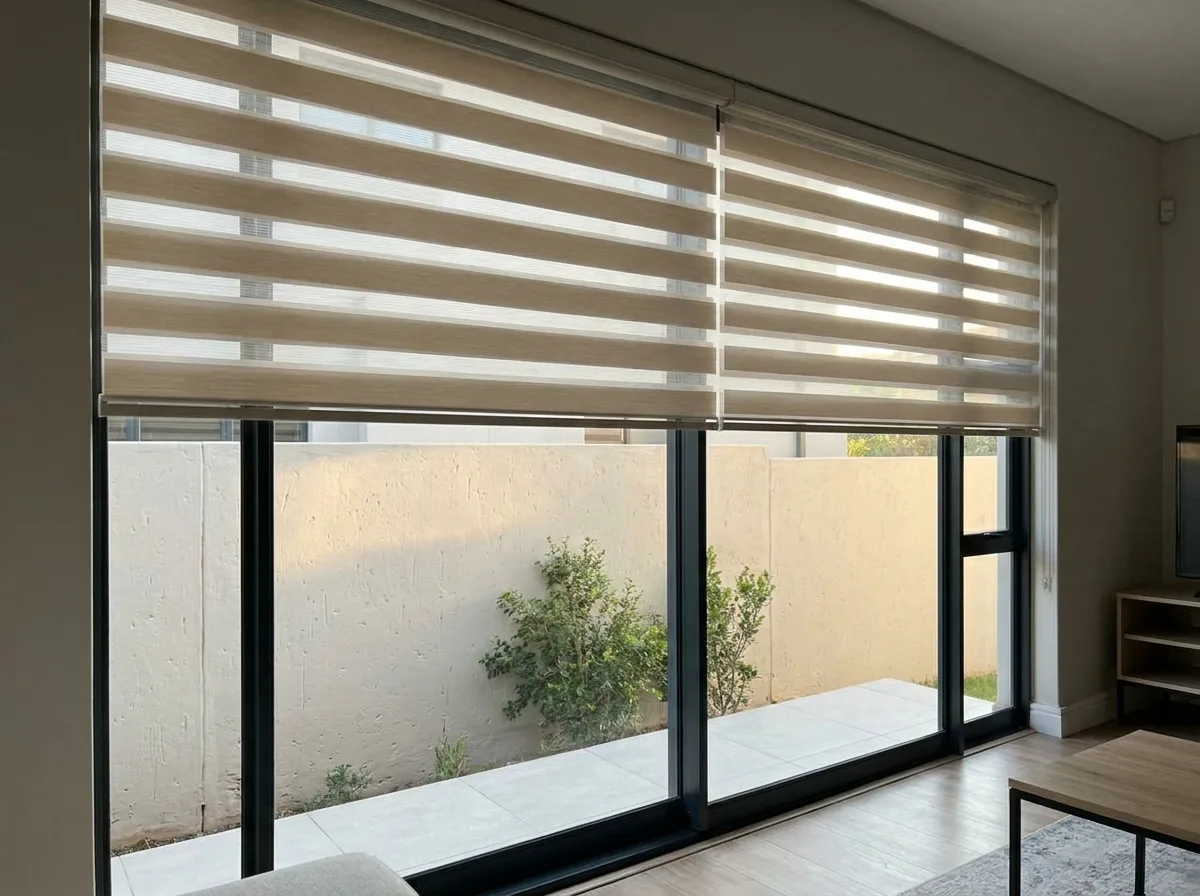
Alternating sheer and solid bands on one smooth sheet: line them up for filtered daylight, offset them for near-solid cover. Where a neighbour’s window is a few metres away, that band-by-band trade beats fabric quality every time — because here the right answer changes hourly.
The honest catch: it is not a blockout — closed, a little light passes, and at night with the lamps on silhouettes read from outside. Blockout for bedrooms; day/night for the living areas.
The everyday workhorse, two fabrics
Roller blinds — sunscreen and blockout
One flat fabric on a tube. Sunscreen, woven at a stated openness (typically 3–10%), cuts glare and ultraviolet while you still see the garden. Blockout answers a five-past-five sunrise. On a double bracket they pair on one window: a day fabric and a night fabric.
The honest catch: sunscreen privacy reverses after dark. And blockout stops the light, not the heat — the pane still warms and radiates inwards, so on a punishing west elevation it darkens the room without cooling it much.
Rooms with no overhang, and skylights
Cellular honeycomb blinds
Pleated cells trap still air against the glass and steady a room’s temperature both ways — useful in a new-build room with all the glazing and none of the eave. They also follow shaped and skylight openings a roller cannot.
The honest catch: more expensive per window, relatively, than a plain roller, and a light-filtering cell gives a glow, not a view.
Kitchens, studies, east glare
Timber or aluminium venetians
Tilt is what a roller cannot do: throw low morning sun up at the ceiling and keep both the daylight and the view. Aluminium shrugs off kitchen condensation; timber warms a living room.
The honest catch: slats hold Highveld dust and are cleaned one at a time, and on very wide openings a venetian gets heavy to lift.
Wide sliders and stacking doors
Vertical & panel blinds
Hanging vanes or wide sliding panels cover a stacking-door opening edge to edge and draw back clear of the door you walk through — the answer where one roller would mean an unreasonably heavy tube.
The honest catch: with the door open and a breeze through it, vanes move and knock. On an opening that lives open all summer, an outdoor product serves better.
Outside the glass: the west elevation and the patio
Roller shutters (shading), zip screens & awnings
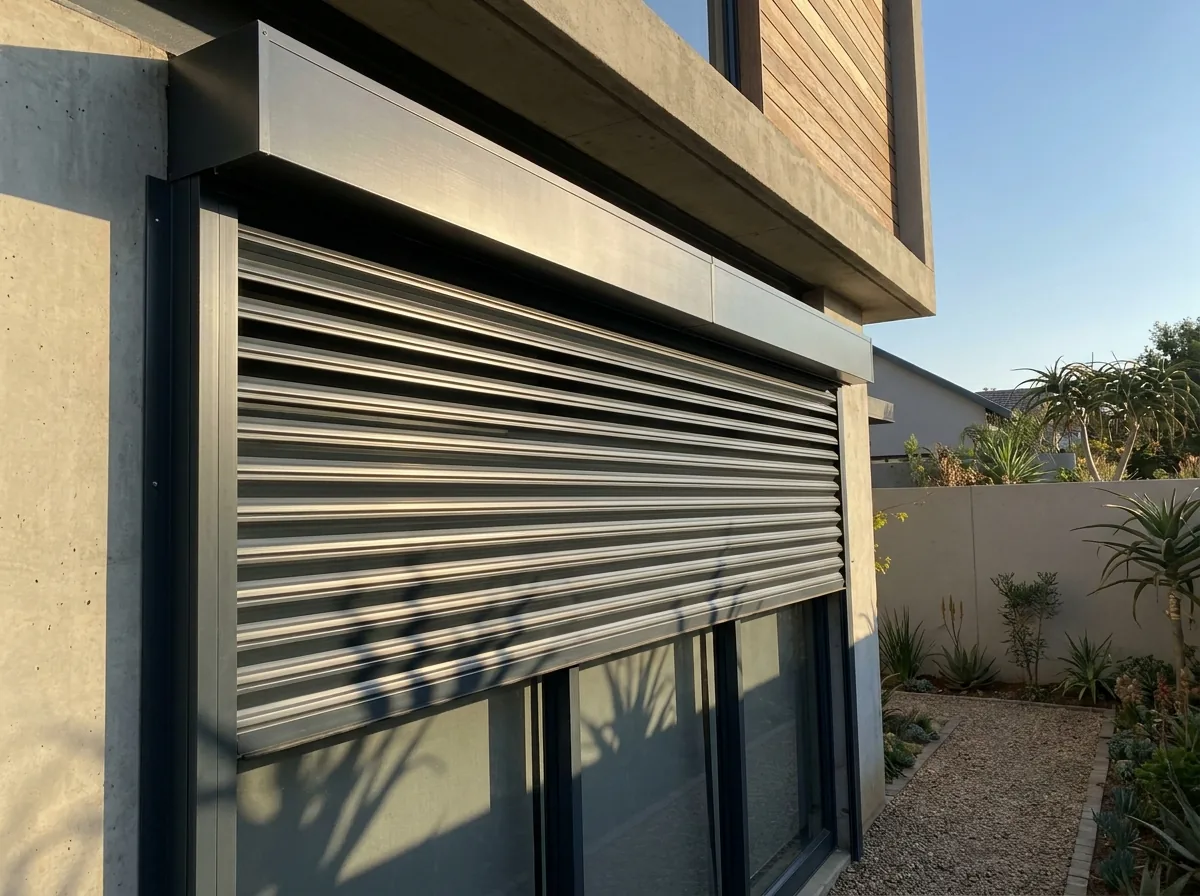
On a west room that is unusable from four o’clock, our first recommendation is to stop the sun before it reaches the pane. External roller shutters — rigid aluminium slats running down guide rails from a slim headbox outside — and zip screens, which hold tensioned mesh in side channels, intercept the heat outside the glass. An interior blockout stops the light, but the pane has already taken the energy and goes on radiating it inwards. A folding-arm awning does the same job over the patio that, on a subdivided stand, often is the garden.
Worth saying plainly: these are shading roller shutters — sun, heat, glare and privacy control outside the glass. They are not security-rated shutters; that is a different product, available on request, and we will never imply one does the other’s job. The honest catch: external work is a bigger job — a sound fixing substrate, a visible headbox, usually a power route, and a life out in Highveld hail and ultraviolet. It costs more, relatively, than anything else here. On a rented house, a tight budget or a heritage-constrained façade, an interior blockout roller is the sensible answer and we will say so.
Renovated ceilings and out-of-reach glass
Concealed blinds & motorisation
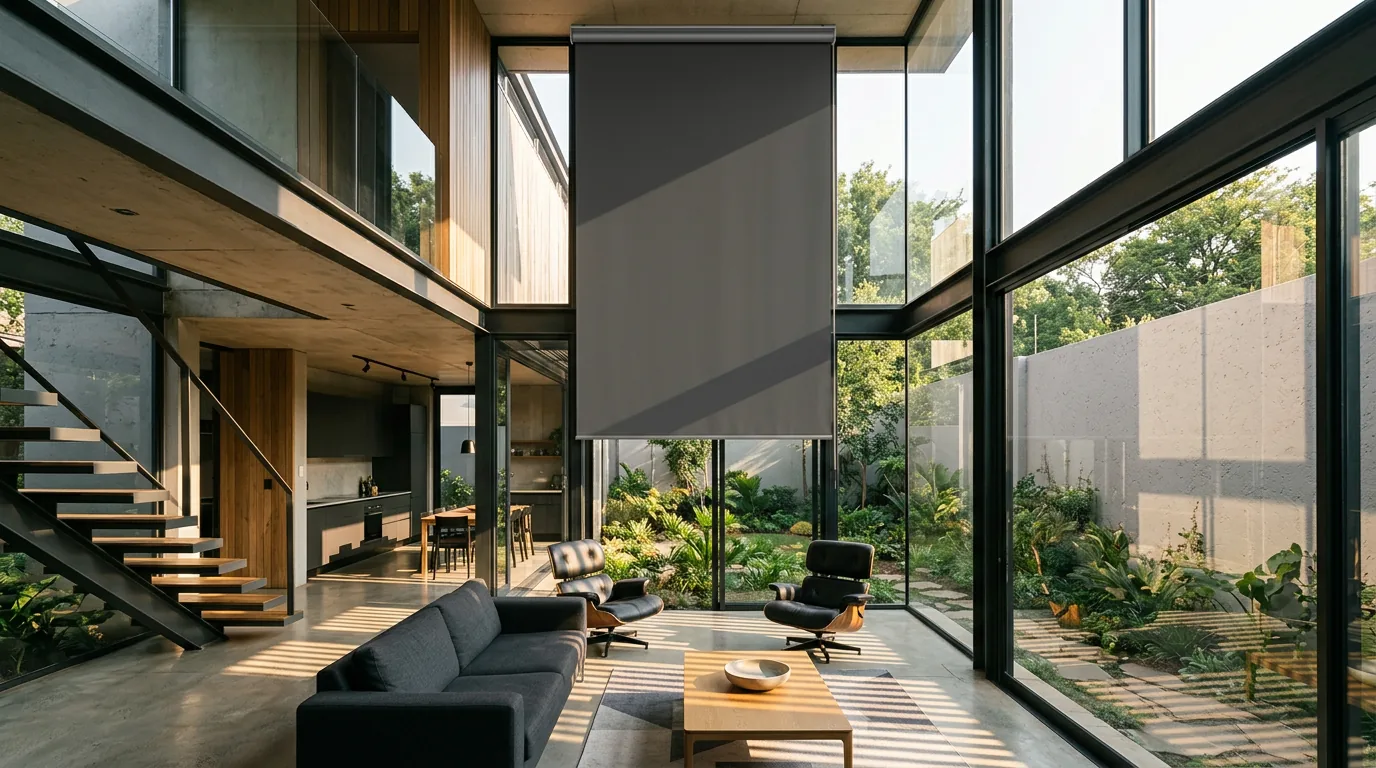
Concealed fabric drops from a slot in the ceiling or a bulkhead: no headbox, nothing interrupting a frameless opening. Because so much of Birdhaven’s stock is a recent renovation, we regularly find a recess already framed for a blind that was never fitted — and using one that exists beats face-fixing onto finished plaster. Motorisation is the other half: in a double-volume room, a chain you cannot reach is a blind that never moves.
The honest catch: both want planning. With no recess, cutting one in a finished ceiling is building work, not blind work, and the mechanism must stay reachable for service. On one reachable window, a motor buys convenience, not performance.
05
Before anyone drills
Old walls, new clusters, and who has to say yes
Birdhaven is a proclaimed suburb, not a gated estate, so no architectural committee sits over it and we are not going to invent one. Two things are still worth knowing.
The sixty-year rule. Under section 34 of the National Heritage Resources Act, nobody may alter or demolish a structure — or part of one — older than 60 years without a permit from the provincial heritage resources authority, and "alter" covers works affecting a building's structure or appearance. Age alone triggers it; the house need not be listed, and Birdhaven was proclaimed in 1949. A blind hung inside a room is not that kind of alteration — but cutting a reveal, chasing a soffit for a ceiling recess or fixing external hardware to an original façade is where a call to your architect or the provincial authority belongs first. We flag it; we are blind makers, not heritage consultants.
The cluster question. Where a stand has been subdivided into three to eight units, anything changing the outside face of the building — a shutter headbox, an awning, a zip-screen channel — is usually the body corporate's business too. Interior blinds are not. Ask before you order: a five-minute email saves a fortnight.
06
The limits of a web page
What we still cannot tell you from here
This Report gets you to the right product. It cannot get you to the right blind: five things decide that, and each has to be measured or tested in the room itself.
The reveal depth, to the millimetre
Whether a blind can sit inside the reveal — and how much light leaks down the sides if it does — comes down to the depth of the recess and how square it is. Renovated openings run a few millimetres off the plan.
What is actually behind the plaster
Brick, block, a steel lintel, a drywall bulkhead or a void with nothing in it — the substrate decides what can be hung, especially anything external or heavy. We tap and check rather than guess.
Where the reflected heat is really coming from
Wall colour, paving, pool position, how close the neighbour is: every stand bounces light differently. Standing in the room late in the day tells us whether a sunscreen alone will do.
Wind exposure on anything outdoors
Awnings, zip screens and external shutters are sized against the exposure of the spot itself, and a courtyard hemmed by walls behaves nothing like a corner open to the park.
Whether motor power can get there sensibly
Motorisation lives or dies on the cable route: straightforward above a bulkhead in a renovation, much less so into a finished double-volume wall. We work it out on site, not as a surprise on a quote.
07
Where to go from here
Two ways forward, and neither costs anything
Recommended
The free expert measure & written quote
A consultant comes to you with fabric and finish samples, walks the elevations at the hour that actually matters, measures every opening by hand, and leaves a written quote itemised per window. Free, and with no obligation at the end of it.
We take five or six measure appointments a week, so the diary fills early — worth booking ahead if you need a particular day.
Pop in rough sizes and we'll send a budget range by the next working day. Not sure how to measure? Leave it out — our consultant measures for free either way, and that visit is where the exact per-window pricing comes from.
One short form. If you'd also like a budget range, add rough window sizes underneath — that part is entirely optional and nobody will chase you for it.
Sources
Where the figures on this page come from
Every sun-path, climate, suburb and heritage figure above is taken from the following. Where a figure was disputed between sources, or could not be verified at all, we left it out rather than round it into a sentence — which is why you will not find an average stand size or a frost-day count anywhere on this page.
Latitude, elevation and solstice sunrise/sunset bearings for Johannesburg — Gaisma, Johannesburg